5 Criteria for Choosing Your Projector
Projectors are winning over more and more users every day. The desire to sit down and truly savour a specific film — rather than channel-surfing on TV — undoubtedly has something to do with it.
Projectors are winning over more and more users every day.
The desire to sit down and truly savour a specific film — rather than channel-surfing on TV — undoubtedly has something to do with it.
The advantages of a projector are equally compelling. Among them:
- An unmatched sense of total immersion
- No more large black rectangle disrupting your living room décor
- An unbeatable cost-per-square-metre for screen size
- Versatility across a wide range of uses
Because the selection criteria for a projector are completely different from those for a TV, many potential users are unfortunately still put off by the format.
There are of course already articles on this subject, but the criteria they cover are often outdated and presented in an overly technical way.
Here, then, are 5 criteria to help you choose your projector.
Feel free to reach out via our LiveChat (bottom right) if you would like more information on any particular point!
Brightness and contrast
A projector's light output is measured in lumens.
The contrast ratio indicates the difference between the deepest black and the brightest white your projector can display.
Brightness and contrast work in opposition: the brighter the image, the lower the contrast, and vice versa.
So if the room you are planning to use is sufficiently dark (i.e. you are not projecting in the living room with the curtains open at 6 pm on a summer evening), there is no need to go beyond 2,000 lumens — 1,500 lumens is generally ideal.
One important point to bear in mind: contrast ratios can vary wildly between models and manufacturers.
This is because there is no universally agreed standard for measuring contrast.
Every manufacturer calculates the figure using their own criteria, which are not the same as their competitors'.
If you plan to use your projector in a brightly lit environment — lights on, or a summer evening without blackout blinds — then a 3,000-lumen projector will be a better fit.
Resolution
Today, Full HD Home Cinema projectors (1920×1080p) have become widely accessible.
This specification indicates the number of lines — in this case 1,080 — that your projector can display.
In theory, the more lines the better.
Why only "in theory"?
Because beyond a certain resolution, the number of displayable lines exceeds what is actually available in today's content.
This is why we generally advise our clients against opting for 4K projectors.
The technology still commands a price premium, while 4K content remains relatively scarce.
A better approach is to invest in an excellent 1080p projector now, then upgrade to 4K when the technology is truly mainstream.
It will cost you less, and you will benefit from a more mature product than the early models.
Noise level
A projector's noise level is a factor that is far too often overlooked — precisely because it is not "visible".
Noise is measured in decibels (dB).
In a projector, it comes primarily from the fans that cool the lamp and the electronic components.
To keep it simple: the smaller the fan, the louder it is — faster blade rotation produces a more audible whine.
Compact projectors therefore tend to be naturally noisier.
Conversely, a larger projector is generally quieter.
This is one reason why premium Home Cinema projectors are often quite bulky.
Another useful benchmark: a whisper registers at around 20–30 dB.
So any projector approaching 30 dB can be considered quiet.
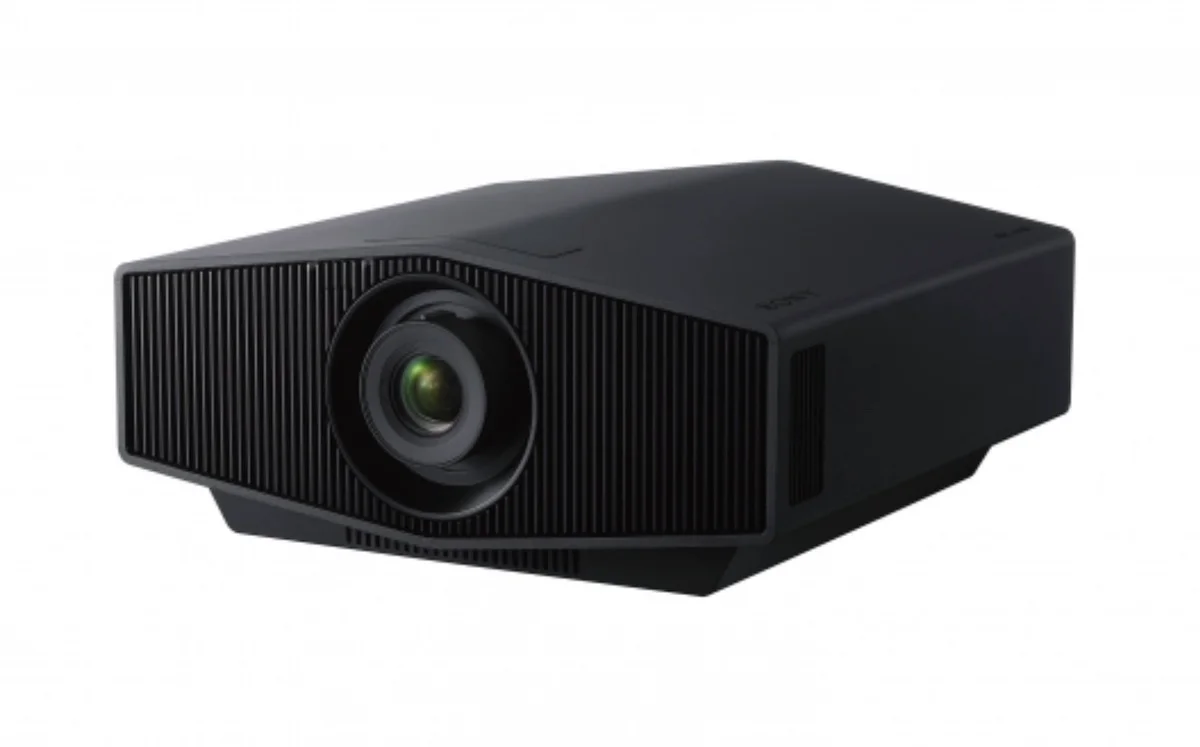
Some models, such as the Sony VPL-VW5000, are virtually silent — though they come at a price.
Physical footprint
The Sony VPL-VW5000 is not only exceptionally quiet; it also delivers a fantastic picture.
Unfortunately, its physical size means it does not easily find a home in every interior.
It is therefore important to decide what footprint is acceptable for you.
Solutions such as motorised projector lifts — like the AluLiftHC — are an excellent choice for concealing the unit and making it completely invisible when not in use.
Which projector technology should you choose?
Three projection technologies currently coexist: LCD, DLP, and LCoS.
LCD technology (or 3-LCD) was developed by Epson.
Its operating principle is based on a system of prisms and mirrors (we will spare the technical details here).
LCD projection technology works via a system of prisms and mirrors.
It is characterised by its compact size and accurate colour reproduction.
Some users do criticise LCD for its relatively low contrast ratio.
This may be why LCD projectors are most commonly found in professional environments —
settings where brightness takes priority over contrast.
DLP (Digital Light Processing), developed by Texas Instruments, uses a chip made up of millions of micro-mirrors that switch on and off in fractions of a second to produce each frame.
This technology delivers excellent brightness, contrast, and overall image quality.
In its early days, a "rainbow effect" was noticed by some viewers, but this has since been completely resolved.
LCoS (Liquid Crystal on Silicon) technology goes by the name SXRD at Sony and D-ILA at JVC. Derived from 3-LCD, it is widely recognised for delivering noticeably higher contrast ratios than either LCD or DLP.
This is why it is typically found in high-end projectors.
That said, some criticism has been directed at SXRD regarding perceived sharpness.
Light source types
Projectors using a traditional lamp as their light source are still the most common on the market today.
Fortunately, innovation continues to bring new, more economical and energy-efficient technologies.
Lamp-based projectors (or bulb projectors) deliver a very bright output but generate a significant amount of heat.
Their relatively short lifespan (2,000 to 3,000 hours), combined with replacement cost, is the main drawback of this type of light source.
It is also worth noting that lamp ageing typically affects both colour accuracy and output as the lamp nears the end of its life.
LED projectors offer a compelling set of advantages over traditional bulb lamps.
With a rated lifespan of 20,000 to 30,000 hours, LEDs last up to ten times longer than a bulb.
At 3 hours of use per day, every day of the year, that translates to a lifespan of 20 years!
Brightness remains the Achilles' heel of LED technology, however.
The output of the diodes limits brightness to a few hundred lumens — just about sufficient for use in a darkened room.
Rapid advances in the technology now make 1,500 lumens achievable for certain models.
The LG PF1500G and AiO — the projector we are currently developing — both deliver this level of output, for example.
One final technology, still relatively uncommon at this stage, is laser.
Its major advantage is that it requires no focus adjustment at the lens.
The downside is cost: laser technology currently runs three to four times the price of LED.
At present, Sony offers the most affordable 4K laser projector on the market.
I hope this deliberately user-focused approach — rather than a purely technical one — helps you find the ideal projector for your setup.
Do not hesitate to get in touch if you would like personalised, no-obligation advice. The team would be delighted to help you make the right choice 🙂